
Endurance and Strength: The Power of the Clan House
The Pulse of the Island: Carrying the Labor of the Ancestors
Strength is often described as a burst of power: the ability to weather a single, violent storm. But in the Tlingit worldview, true strength is something much more quiet, much more resilient, and infinitely more enduring. It is the ability to remain rooted through thousands of years of shifting tides, glacial advances, tsunamis, and the relentless, grinding pressures of colonialism and cultural suppression.
We are still here.
That simple fact is the foundation of my latest work, “Endurance and Strength: The Power of the Clanhouse.” I am incredibly honored to share that this piece has been selected by the Sealaska Heritage Institute (SHI) to visually represent Celebration 2026. When the thousands of dancers, elders, and families gather in Juneau from June 3-6, this design will serve as the logo for the event. Appearing on everything from the posters and social media to the retail items that people will carry home. To have my work chosen to reflect the theme of Enduring Strength is a responsibility I don’t take lightly. It is a visual meditation on Ha Shagoon, the understanding that we exist on a continuum, carrying the labor of our ancestors forward for the benefit of those yet to be born.
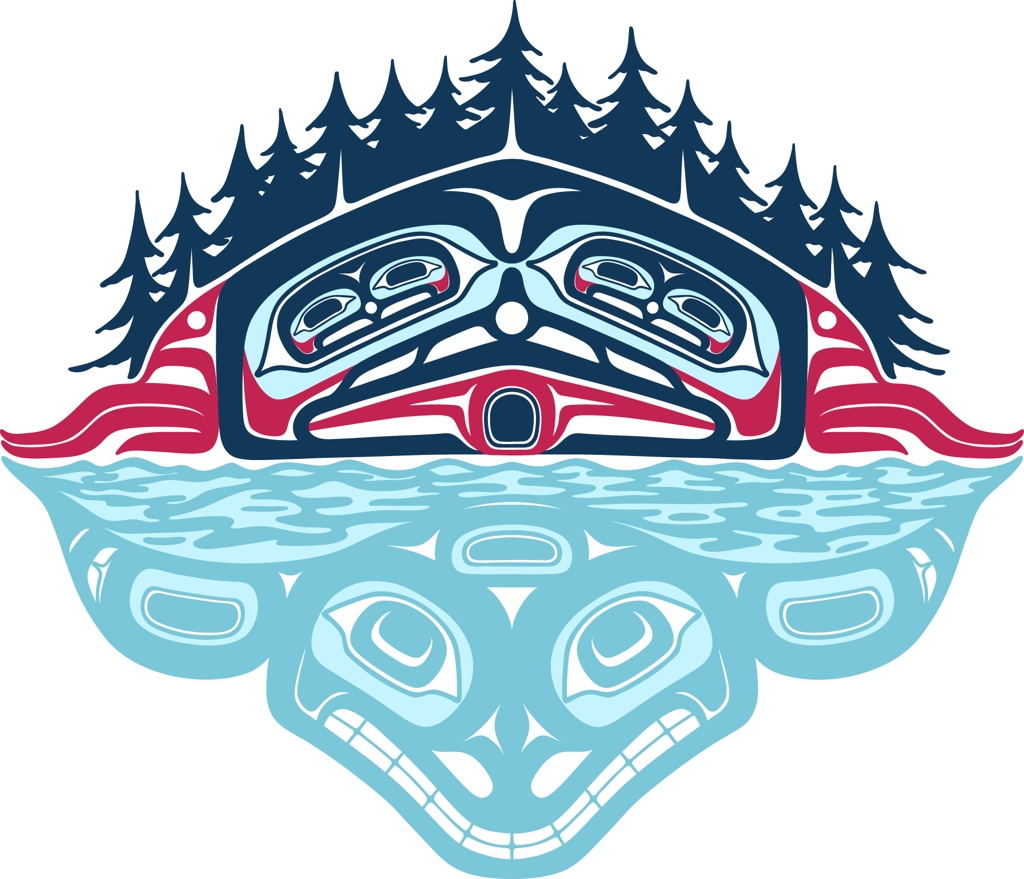
“Endurance and Strength: The Power of the Clan House,” the official Celebration 2026 logo, featuring the diamond‑shaped duality of land and sea. Image courtesy of Sealaska Heritage Institute. Their official Celebration 2026 press release
The Sleeping Giant: The Clanhouse as Foundation
The central figure of this piece is the Clanhouse, depicted as a “sleeping giant” that forms the very foundation of the island itself. In our tradition, the Longhouse is more than a shelter; it is the heart of the family lineage and the primary vessel for the transfer of knowledge.
When I sat down to create this, I thought about the power of the matrilineal clan structure. As I mentioned in my interview with SHI, this structure has allowed us to endure through numerous pressures. It’s because we can lean on each other and learn from each other that we remain so strong as a people.
I have rendered the house-front with a protruding tongue, which in our visual language signifies the passing of wisdom. The entrance to the house is through this tongue. This is a deliberate metaphor: when we “go home” to our clan, we are entering a space of learning and collective power. You might spend your season out on the water fishing, or in the woods gathering cedar bark and berries, but when the brutal Southeast Alaskan winter hits, you return to the Clanhouse. You return to resonate with your family, to share what you’ve seen, and to gain the knowledge others have brought back.

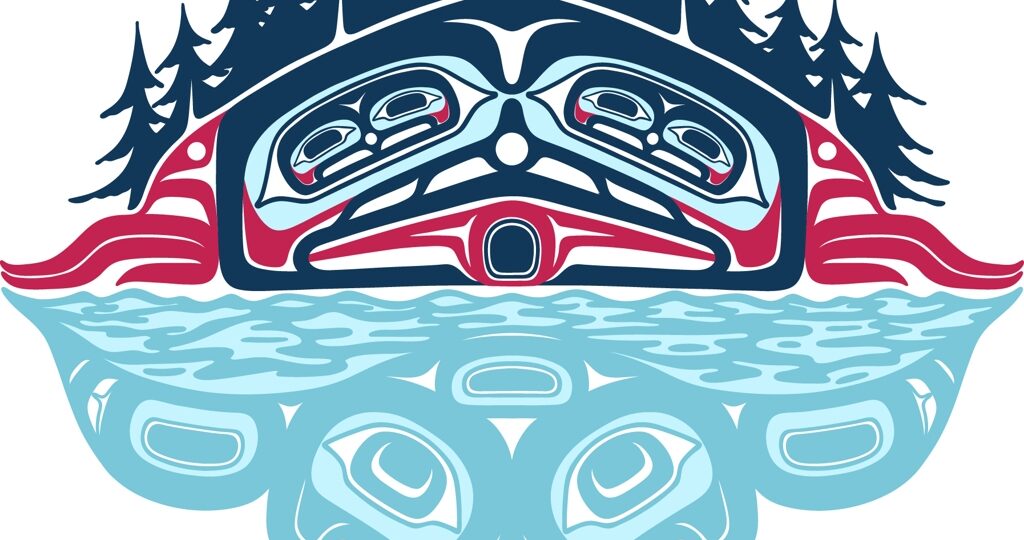
Detail of the upper figure and Clanhouse façade, showing the formline trees rising from the brow line. Image courtesy of Sealaska Heritage Institute.
To represent our role as stewards, the figure’s hands extend to the sides, laying flat to feel the “pulse” of both the land and the sea. This reflects a two-way relationship of care: we support the trees and the mountains, and in return, they support us. The island isn’t just a place we live; it is a living entity we are in constant conversation with.
The Duality of Land and Sea
The composition follows a diamond-shaped duality, contrasting the trichromatic (red, black, and blue) world of the land with the monochromatic blue world of the sea. This stems from a traditional Tlingit worldview that balances the “Known” and the “Opportunity.”
The Land (The Known):
The upper figure represents the safety and grounding of the Clanhouse. It is the place where we find refuge from the environment and where our history is stored.
The Sea (The Opportunity):
Below the surface swims the Orca.
I chose the Orca because they are, like us, deeply family-dependent pack animals. Their success as individuals is entirely dependent on the strength of their pod. In the design, the Orca is shown heading outward, representing the Tlingit spirit of exploration and risk. While the Clanhouse is our grounding, the ocean is our opportunity. We take the knowledge we gained in the house and we carry it out into the wild, unpredictable waters of the world.
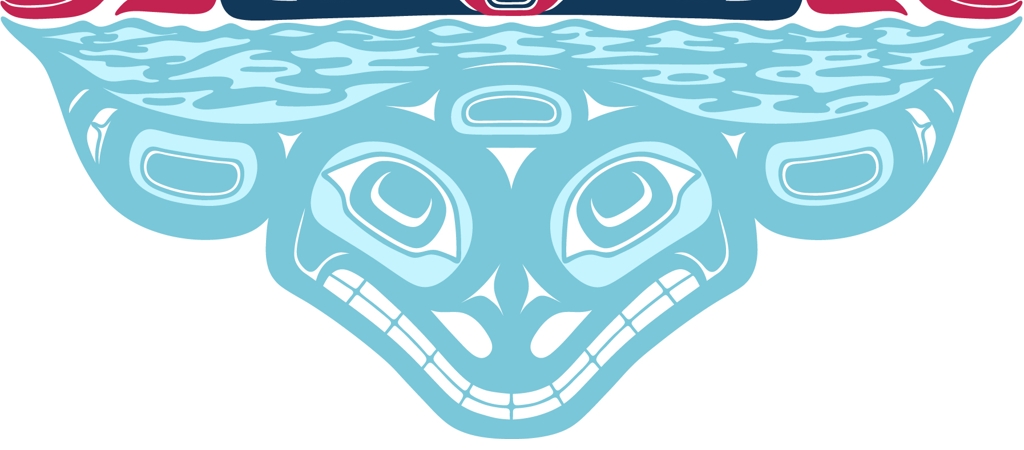
Close‑up of the Orca rendered in monochromatic blue, symbolizing exploration, opportunity, and the strength of the pod. Image courtesy of Sealaska Heritage Institute.
The monochromatic blue of the Orca was a choice of visual weight. I wanted the Clanhouse to feel heavy and grounded, while the Orca represents the fluid, shifting nature of the sea. By using shades of blue, the bottom of the piece carries less visual “gravity,” allowing the viewer’s eye to rest on the foundation of the house above.
A Legacy of Adaptation
My journey as an artist has been one of blending the old with the new. I grew up in Ketchikan, creating art since I could hold a crayon, but my path eventually led me to study computer science at the University of Alaska Fairbanks and Purdue. People often ask how a “tech guy” ends up doing traditional formline design. To me, there is no contradiction.
Our ancestors were masters of adaptation. We transitioned from seashell knives to beaver teeth, then to drift-iron from Asiatic shipwrecks, and eventually to steel and copper. We didn’t stop being Tlingit because we used a better blade; we used the better blade to make our art more refined.
This digital piece is a continuation of that. The software I use is just another tool, like the adze or the brush. In Tlingit culture, we have always attached our stories to our tools—our paddles, our spoons, and our clothing. We ensure that our culture is not a static artifact in a museum, but a living, breathing masterpiece that evolves with us.
As I worked on this piece, I found myself thinking about the people in my own family who embodied that same endurance. My great aunt, Marlene Johnson, passed recently, and her legacy as a leader and advocate for our people has been on my mind. She spent her life fighting for Alaska Native rights and shaping the world my generation now stands on. In many ways, the strength reflected in this design is the same strength she carried so fiercely.
Looking Toward Celebration 2026
As we prepare for Celebration 2026 in Juneau, the theme of Enduring Strength feels more relevant than ever. We are currently facing new “tidal shifts,” from climate change to the continued work of language revitalization.
The formline convention in this piece includes a thick brow line that holds the design together for each entity. You’ll notice the form is thickest in the trees and the Orca, and slightly thinner in the Clanhouse itself. This was intentional. The stewardship responsibilities of our land and ocean are much too large for a single clan to manage. We need the tribes of Southeast Alaska to work in concert, the Tlingit, Haida, and Tsimshian, to effectively care for our home.

Detail of the formline joinery and digital brushwork used to shape the traditional forms with contemporary tools. Image courtesy of Sealaska Heritage Institute.
When you see this design in 2026, I hope it serves as a reminder. As long as we keep our pulse on the land and our lines of communication open within our Clanhouse, we can navigate any tidal shift the future holds. We are the descendants of those who refused to be swept away, and we are the ancestors of those who will continue to thrive on these shores.
I look forward to seeing you all in Juneau. June 3–6, 2026. Let’s celebrate the strength that has carried us this far, and the endurance that will take us even further.