Ancestral Echoes: A Tlingit Canoe for Celebration 2026
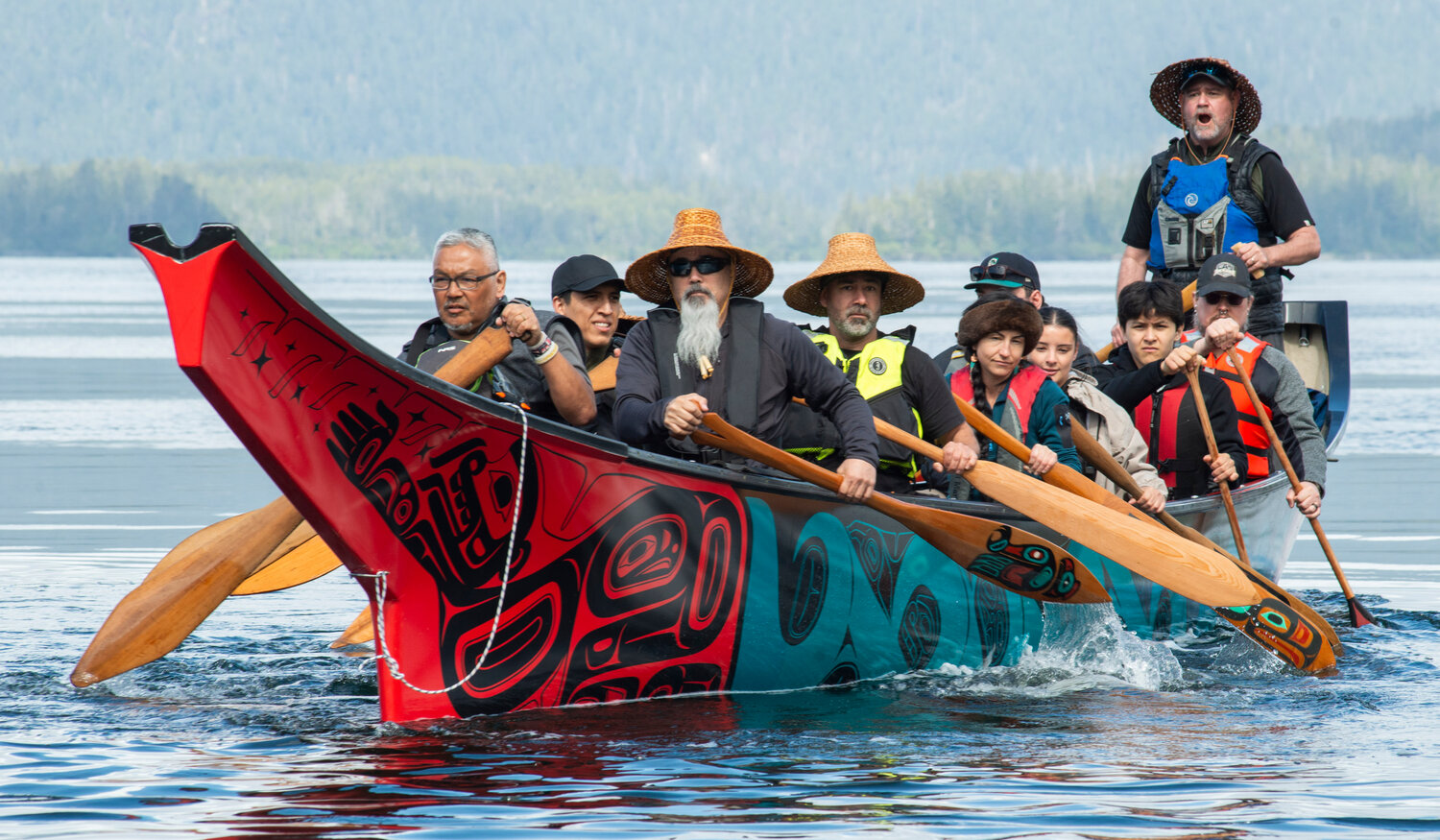
For the last month, I have been working on a new piece for the Southeast Alaska Regional Health Consortium, pronounced “search”. This project is a 40-foot fiberglass canoe that will travel from Sitka to Juneau for Celebration 2026. Because of the scale and the environment, we are wrapping the boat in vinyl rather than using traditional paint.
I call this piece Ancestral Echoes. It is a visual timeline of Tlingit identity, a design that maps our narrative by honoring the masters of the past, acknowledging the resilience of those who survived the Quiet Period, and celebrating the agency of the current generation working toward collective wellness.
The core of this story is the master-apprentice relationship. In traditional culture, knowledge was passed directly from a master to a student through rigorous, hands-on training. This chain was broken by history. Not only through the boarding school era, but through the broader drift toward Western individualism, a pull that drew people away from their villages and away from the formal transmission of knowledge. Many of our ancestors were not simply denied agency. They were going with the waves. They were navigating an overwhelming current of change, and in doing so, they kept us alive. But the cost was the severing of that ancestral knowledge transfer. That gap persists today, and it is what this canoe is about.
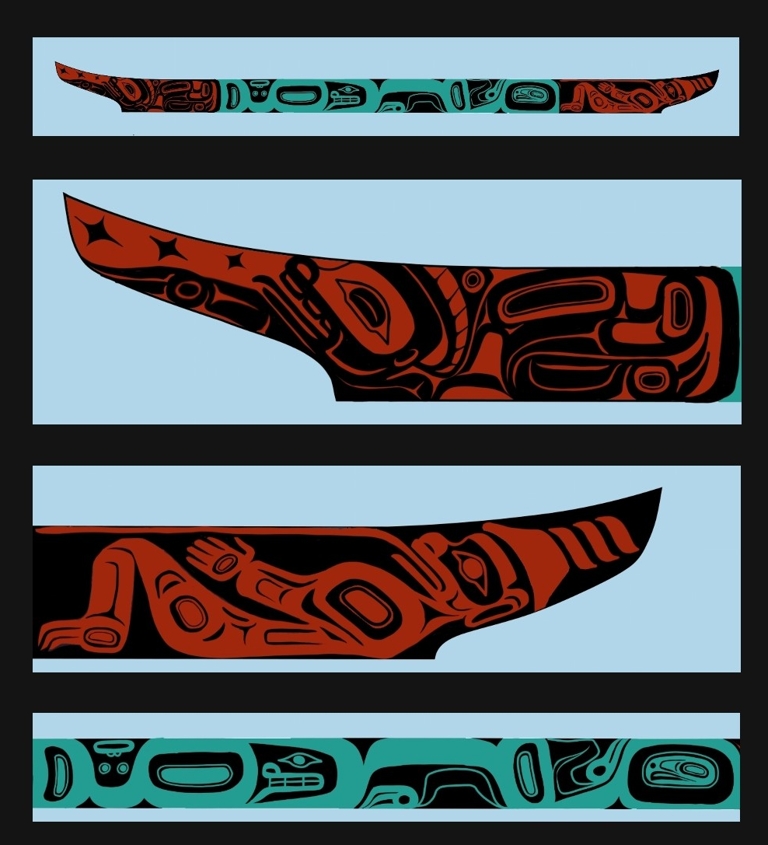
The original design proposal. The three sections were always the foundation of the concept.
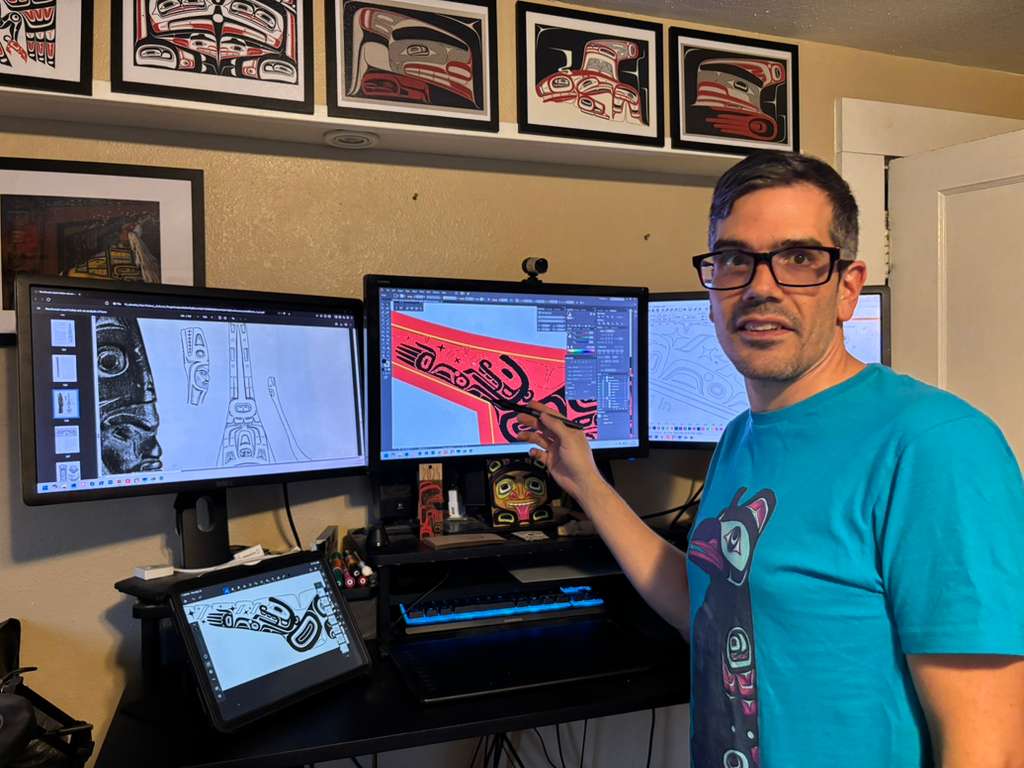
The full digital workflow: archival reference on the left, canoe template in the center, color design on the right. The iPad is where the initial drawing happens before it moves to the desktop.
The Stern: Guidance of the Masters
The story begins at the stern. In Tlingit tradition, the stern is where the canoe is steered and corrected. It represents our True North: a reminder that our roots are deep and that the original instructions remain valid.
In this section, I have depicted a reclining figure against a black background. The figure is red and wears a crest hat with three rings, indicating high status. This figure represents the pre-contact and fur trade eras, what anthropologists call the Golden Period, when the culture was fully intact and the art form was at its most refined.
The posture of the figure is not passive. It is one of established authority. I have included an extended tongue to symbolize the sharing of knowledge. But this tongue does not reach the other end of the boat. It stops at the first wave, marking the exact moment where the transmission was severed.
The stature of the figure is thin and frail. This reflects how ancestors who have passed are often depicted in carvings. They are not emaciated, but their age and their transition to the spirit world are visible. To ground the piece in our matrilineal history, I added a fine line below the lip representing a labret piercing. It is subtle, done in fine line, but it is there, honoring the women who held this culture together.
There is one more layer in this section that I want to name directly, because it matters to me as the artist. Between the master’s arm and thigh is a small figure rendered entirely in fine line. You will not see it from forty feet away. But as you walk up to the boat, it begins to reveal itself. This figure represents a liminal spirit, a transformation presence, ready to carry the master’s knowledge into the spirit world. The form references a land otter halibut, a being associated in our tradition with travel between realms. And just outside of this figure, between the ancestor and the spirit form, is a star. That star is the master himself, already becoming an ancestor. He has not disappeared. He has moved on. And the figure at the bow is reaching toward him.
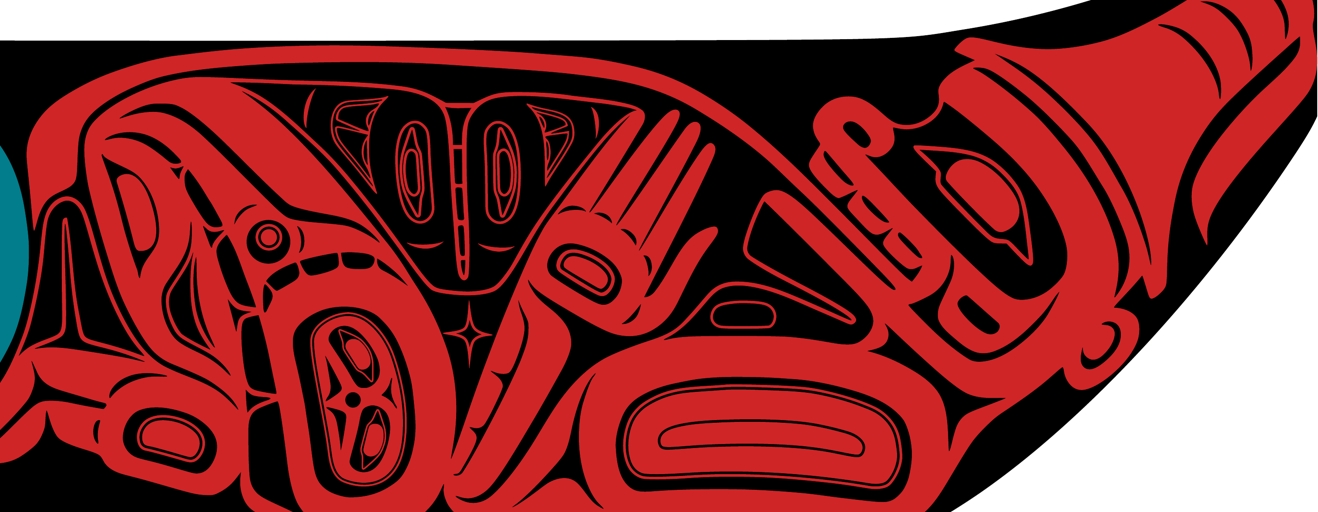
The stern figure. Red on black, reclining in authority. The tongue reaches toward the future but stops at the first wave.
The Mid-Section: The Quiet Period
Connecting the past and present is the mid-section. This represents the Quiet Period, an era of aggressive colonialism, the banning of potlatches, and the boarding school system. During this time, our art and our language were forced underground.
I used teal as the primary color for this section to reflect the movement of water and the thin veil between the physical and spirit worlds. Instead of rigid figures, I used large, crashing waves with traditional trigon and crescent reliefs. Between these waves are embellished ovoids: ravens on the starboard side and eagles on the port side, representing the two moieties of the Tlingit people.
Within the teal forms, I included human faces, wings, arms, and legs, as if people are being tumbled through the water. This imagery came directly from my time surfing in Hawaii during undergrad. When you crash on your board, you get tumbled. You do not fight the wave. You go with it and wait for the surface to find you again. That is the metaphor here. Our ancestors did not break against the currents of history. They bent. They flowed. And because they did, we are still here.
What I want to say clearly, though, is that this is not simply a story of victimhood. There are four generations of people in those waves. Some of them had no choice. The children sent to boarding schools had no choice. But others were navigating decisions, accepting Christianity, accepting capitalism, going along with a civilization that was offering them something. The Quiet Period is more complicated than a door being slammed. It is about missing the boat on ancestral knowledge without even fully knowing it. The faces in these waves are the ancestors who kept our stories alive, even when the strict conventions of the form had already begun to fade from memory.
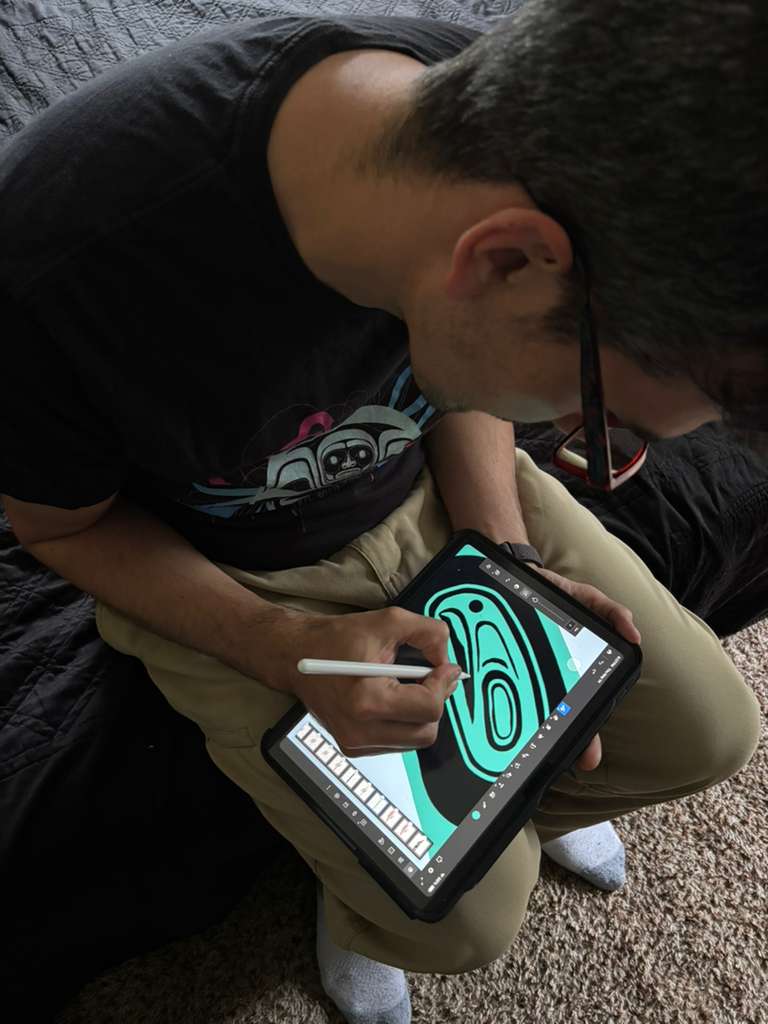
Building the mid-section ovoids on the iPad. The teal forms each contain embedded figures, faces turned in different directions as if tumbling through water

The mid-section in full. Four generations of ancestors, tumbled by history, still present in the form.
The Bow: The Driving Generation
At the bow, the colors flip. The background is red and the figure is black. This represents the Resurgence, from the 1970s to the present day. We are no longer quiet.
The figure here is an apprentice. Unlike the reclining master in the stern, this figure is in a posture of exertion and agency: Kneeling, crouched forward, crawling out of a wave; A hand and tongue extended, reaching upward toward the stars and the aurora borealis. In our traditional worldview, when the stars are out and the northern lights are dancing, our ancestors are present with us. This figure is reaching for that specific ancestor who became a star in the stern. That connection is the whole story of the canoe.
The figure is physically full, with a large chest and belly, representing a living person who is alive and well in the modern world. I added a split U projecting from the top of the head in fine line to echo long hair, which in our modern world signals femininity. The matrilineal thread runs through both ends of this canoe, quietly, in fine line, because that is how it survived.
I also encoded my own process into this figure. If you look at the bow figure in reverse, the hip and leg form an image of someone looking backward through time, back through the waves, back toward the ancestor. The foot is actually an arm, resting on a U-form that represents a computer mouse. The hip joint is a computer screen. That is me. That is how I have spent years studying the masters: pulling images from museum archives online, looking at old boxes and crest hats and rattles and shaman charms, trying to understand the forms that the masters understood intuitively. I put myself in this piece because this canoe is also a record of where I am right now in my own journey as an artist.
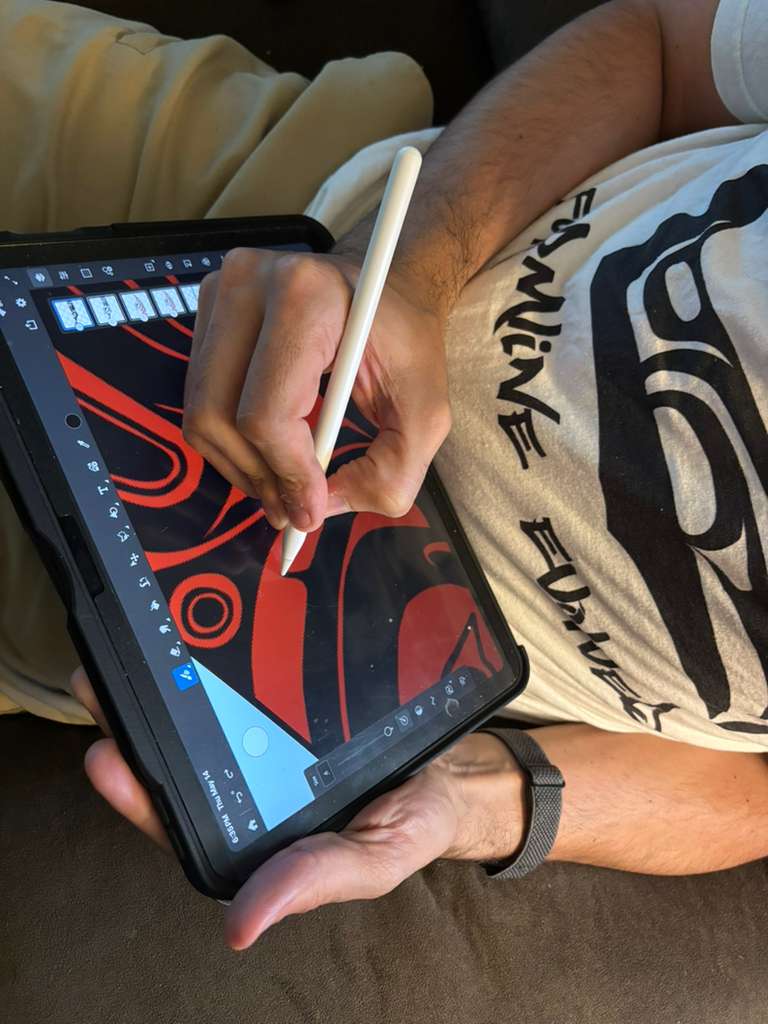
Building the bow figure. The black on red reads as urgency compared to the authority of the black-background stern.
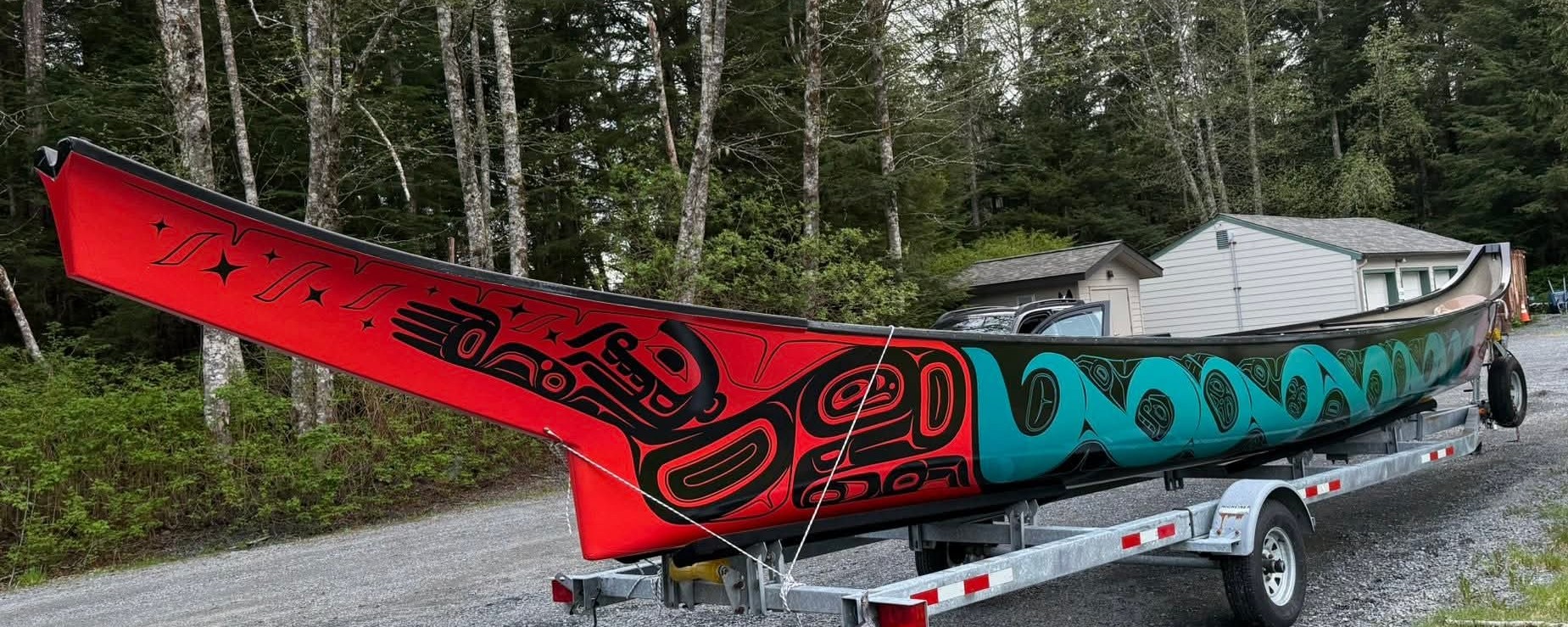
The canoe on the trailer before launch. The stars above the figure are visible here, and the transition from red to teal reads clearly at this angle.
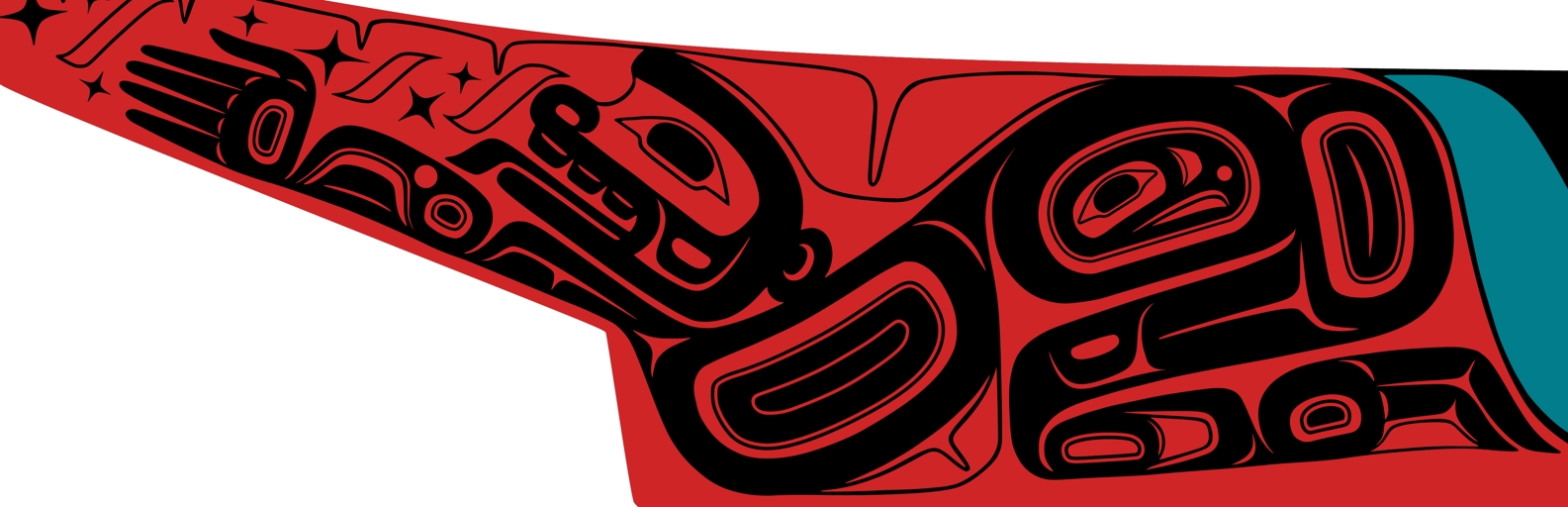
The hidden image in the bow figure. The foot is an arm resting on a computer mouse. The hip joint is a screen. That is me, looking back through the archives toward the masters.
Reconstructing the Form through Data
Because the masters are now silent, I have had to find other ways to listen. For years I have been crawling museum databases, downloading images, and building an SQL database tagged with a specific vocabulary of formline elements. By running analytics across thousands of artifacts, I can begin to distinguish between a one-off variation made by a single artist and a coherent fundamental of the form, something that appears again and again across centuries, across clans, across regions.
This is the same work that Bill Holm did in the 1960s, but he was working with index cards. I am working with a database. I can run queries. I can generate visual graphics over the statistical results. I can pull on a thread and see where it goes across hundreds of objects at once.
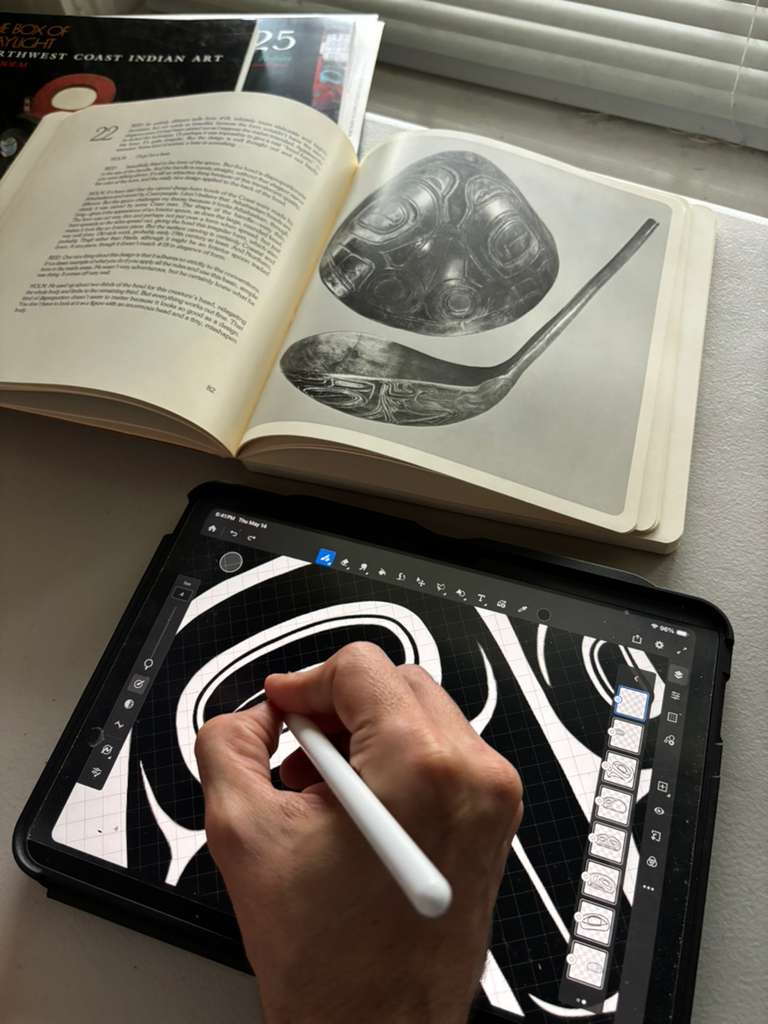
The research is inseparable from the drawing. Form and Freedom book by Bill Reid is open. The database and the pencil are the same tool.
This research is informing a Formline Fundamentals course I am building. The goal is to give students a structured, rigorous path into the archaic forms, the same forms the masters were working from before the Quiet Period interrupted the lineage. When an artist has a strong base in fundamentals, they have the freedom to evolve. They can take that foundation into graffiti, comic book art, synthwave, whatever lives in their heart. But without that foundation, they carry the Quiet Period echo forward and do a disservice to the tradition, even if unintentionally.
That is what I am trying to interrupt. The canoe carries this story across the water and the curriculum carries it into the classroom. They are the same project.
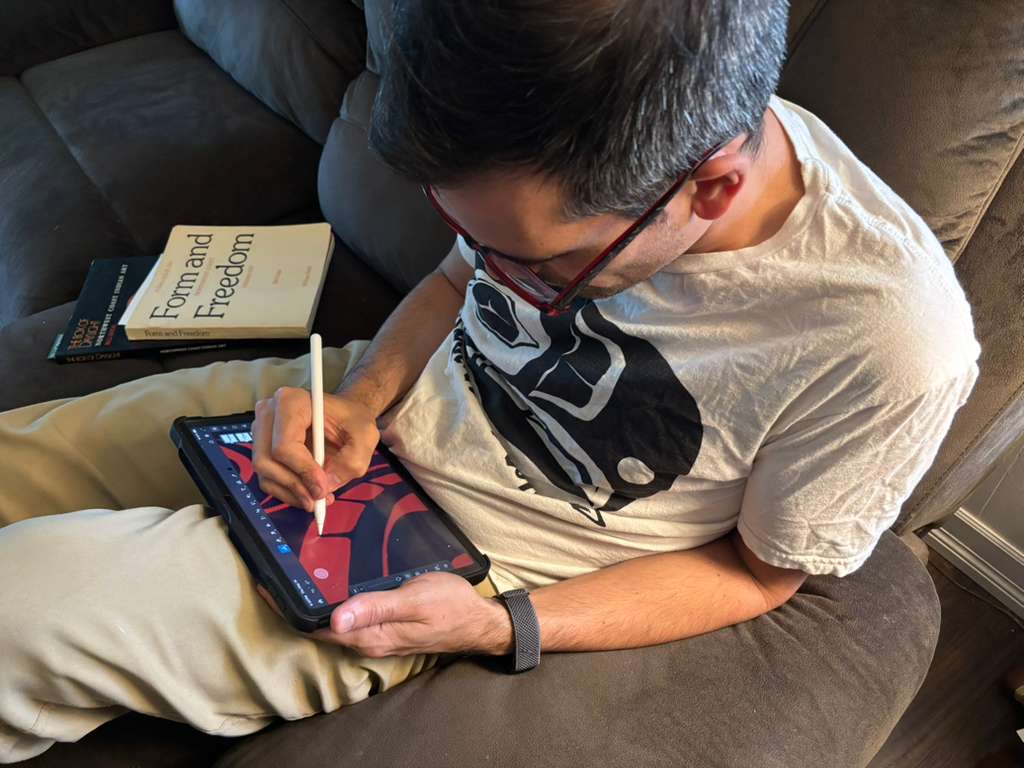
Form and Freedom open beside the iPad. This is what the research process actually looks like: moving between the archival sources and the digital canvas, back and forth, until the form starts to make sense.
Healing Through Active Presence
I now teach painting workshops in the Puget Sound area. We do not carve in these classes. I provide the formline design and instruct on how to paint clean lines, how to understand color, balance, negative space, and composition. And the act of doing that, of sitting down and focusing on something that demands your full attention, is healing in itself. We do not take enough time for active quiet in this modern world. Watching a show is passive. Painting is not.
But the deeper healing is about identity. I have had people sit down at my table at a vendor event and ask question after question about the art form, and then tell me they are Tlingit themselves. They have always felt a pull toward this work, but never had the vocabulary for it. That surprised me at first, because I grew up in Southeast Alaska with a carver for a father and Nathan Jackson as a mentor. I did not fully understand how fortunate I was until I left.
When a student learns why a form is shaped a certain way, why the cheek is a secondary component, why the ovoid works the way it works, how the pieces fit together like a puzzle, something shifts. There is a validation that happens that words cannot fully describe. Only the paint can do that. I can tell a student a hundred times that the cheek is red. However, the only time they truly understand it is when they accidentally paint it black, wait for it to dry, and correct it with red. That mistake cements it. They will never make it again. That is muscle memory. That is the hand reconnecting with the knowledge.
I remind my students that I have been doing this for nearly three decades. A student trying to hold a clean edge in a three-hour session is not failing. They are learning how to hold the brush while simultaneously reclaiming their culture. Those are two things happening at once. That is enough.
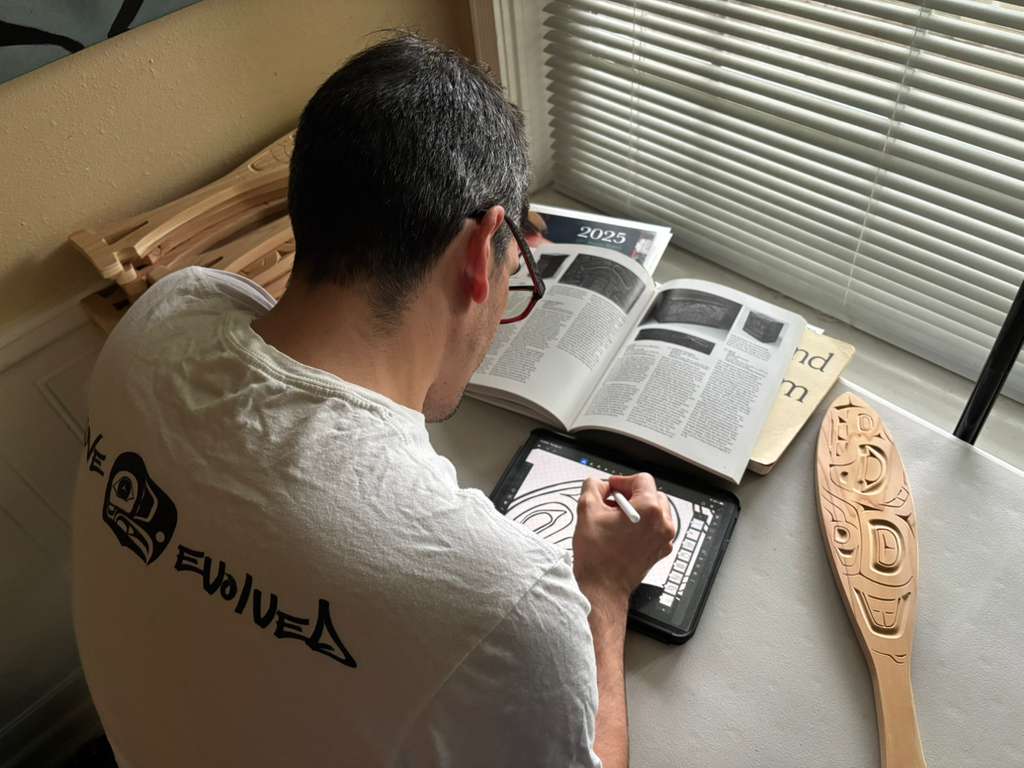
The carved paddle sits beside the iPad. The hand that draws the line and the hand that holds the brush are the same hand. The digital and the physical are not separate practices.
The Ongoing Journey
The canoe will travel from Sitka to Juneau, carrying this story across the water. It is a visual record of the journey from the mastery of the past, through the turbulence of the Quiet Period, and into the agency of the present.
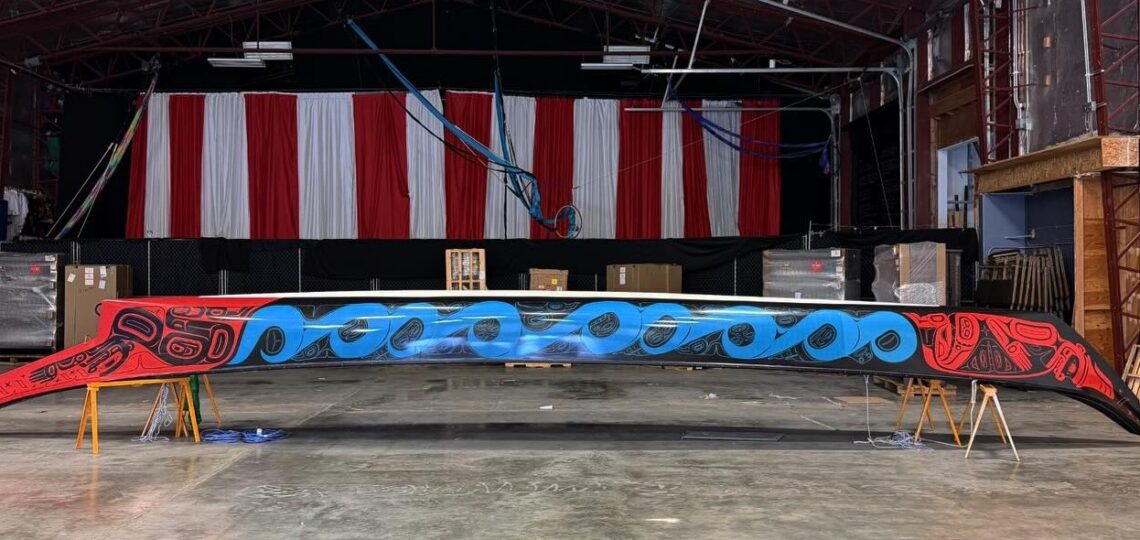
The decision to use three separate monochromatic sections, red in the stern, teal in the mid-section, and black in the bow, was about using constraint as a storytelling tool. If I had made the whole piece trichromatic, the distinct eras would dissolve into each other. Monochromatic formline exists as a convention. I used that convention as a marker. Each section reads as its own complete piece. Together, they tell a single story that spans centuries. I have not seen this done before across a single object in quite this way, and it came directly out of working within the form rather than against it.
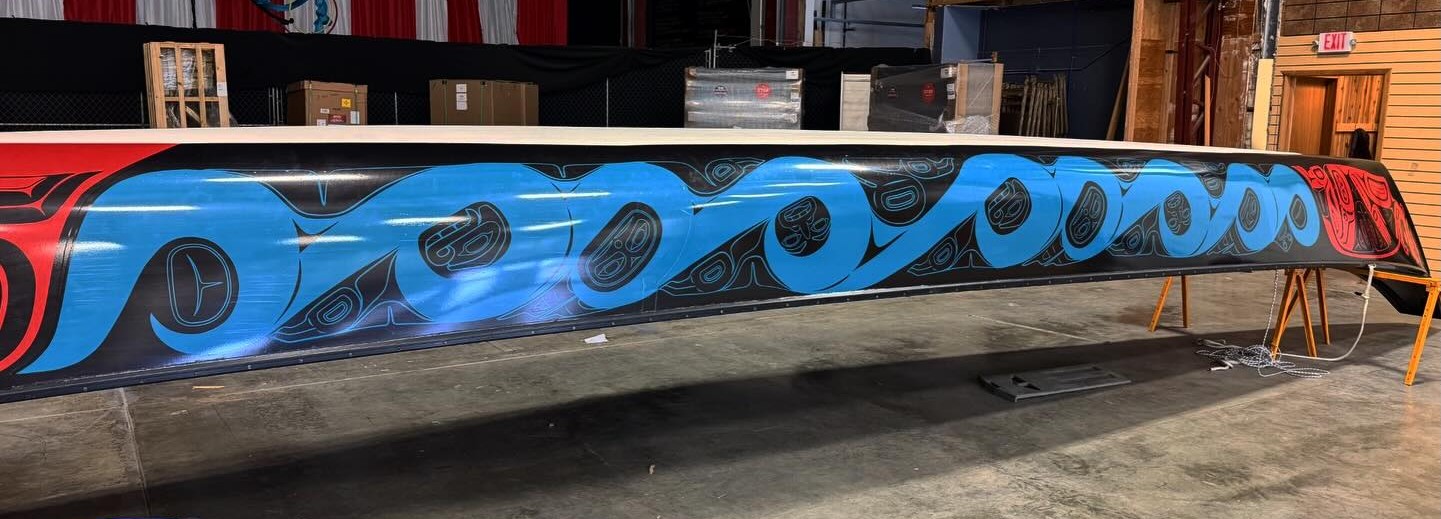
The full wrap, photographed after installation. At 40 feet, the three eras read as a single continuous story.
I want to be clear about what this piece is saying, and what it is not. The Quiet Period was not only imposed. It was also, in part, navigated. Our ancestors made choices. Some had no choice at all. Others were going with the waves, accepting a new civilization, moving through it, keeping themselves and their families alive. We should honor all of them for enduring. But we also need to say out loud that the art produced in that period does not always reflect the conventions of the masters. We do not say that to diminish those ancestors. We say it so that the next generation of artists knows where to look. Look past the Quiet Period. Look toward the old boxes, the old crest hats, the old shaman charms. That is where the fundamentals live.
We are not lost. We are learning our language and our lines again. This canoe is a signal that there is ancestral knowledge worth finding, and that the masters, silent as they are, are still reaching toward us.